· H2 Mathematics — Ten-Year Series, worked ← All 11 questions

2015 A-Level · Paper 1 · Question 3

2015 H2 Maths Paper 1, Question 3

Integration 5 marks limit of a sum · definite integrals
Download Paper 1 solutions (PDF)

Part (i)

2 marks

Approach: Interpret the sum as an area. Split [0, 1]\lbrack 0,\ 1\rbrack into nn strips each of width 1n\frac{1}{n}, and build a rectangle on each strip whose height is the value of ff at the strip’s right endpoint.

1n{f(1n)+f(2n)+…+f(nn)}\frac{1}{n}\left\{ f\left( \frac{1}{n} \right) + f\left( \frac{2}{n} \right) + \ldots + f\left( \frac{n}{n} \right) \right\}

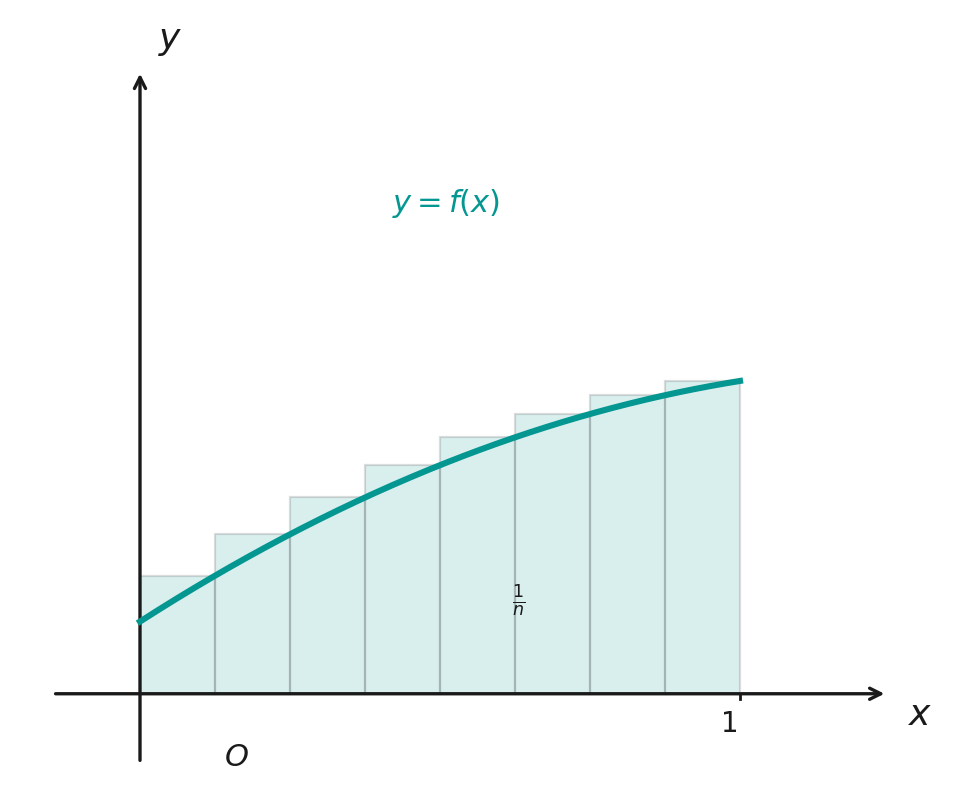
is the total area of nn rectangles, each of width 1n\frac{1}{n}, with the kk-th rectangle having height f(kn)f\left( \frac{k}{n} \right), as shown:

Sketch for question 3

This sum is the total shaded area, which approximates the area under y=f(x)y = f(x) from x=0x = 0 to x=1x = 1. As n→∞n \rightarrow \infty, the width 1n\frac{1}{n} of each strip →0\rightarrow 0, so the rectangles fit the curve more and more closely, and (since ff is continuous, so has no jumps for the rectangles to overshoot or undershoot indefinitely) the total rectangular area converges to the exact area under the curve.

∴lim⁡n→∞1n{f(1n)+f(2n)+…+f(nn)}=∫01f(x) dx.  (shown)\therefore\lim_{n \rightarrow \infty}\frac{1}{n}\left\{ f\left( \frac{1}{n} \right) + f\left( \frac{2}{n} \right) + \ldots + f\left( \frac{n}{n} \right) \right\} = \int_{0}^{1}f(x)\, dx.\ \ \left( \text{shown} \right)

Part (ii)

3 marks

Approach: Write the given limit in the standard form of part (i) by pulling n3\sqrt[3]{n} inside each term of the sum.

lim⁡n→∞1n(13+23+…+n3n3)\lim_{n \rightarrow \infty}\frac{1}{n}\left( \frac{\sqrt[3]{1} + \sqrt[3]{2} + \ldots + \sqrt[3]{n}}{\sqrt[3]{n}} \right)
=lim⁡n→∞1n{1n3+2n3+…+nn3}.= \lim_{n \rightarrow \infty}\frac{1}{n}\left\{ \sqrt[3]{\frac{1}{n}} + \sqrt[3]{\frac{2}{n}} + \ldots + \sqrt[3]{\frac{n}{n}} \right\}.

This is exactly the sum in (i) with f(x)=x3=x13f(x) = \sqrt[3]{x} = x^{\frac{1}{3}}. Hence by (i),

lim⁡n→∞1n(13+23+…+n3n3)=∫01x13 dx\lim_{n \rightarrow \infty}\frac{1}{n}\left( \frac{\sqrt[3]{1} + \sqrt[3]{2} + \ldots + \sqrt[3]{n}}{\sqrt[3]{n}} \right) = \int_{0}^{1}x^{\frac{1}{3}}\, dx
=[34x43]01= \left\lbrack \frac{3}{4}x^{\frac{4}{3}} \right\rbrack_{0}^{1}
=34.= \frac{3}{4}.
To check your answer: taking n=106n = 10^{6} numerically gives 1n(13+…+n3n3)≈0.750000\frac{1}{n}\left( \frac{\sqrt[3]{1} + \ldots + \sqrt[3]{n}}{\sqrt[3]{n}} \right) \approx 0.750000, matching 34\frac{3}{4}. ✓

∴\therefore the limit is 34\frac{3}{4}.

This is how we mark, and how we teach.

Every Ten-Year Series question, worked in full, with the reasoning written out and the traps named.

Find out more