· H2 Mathematics — Ten-Year Series, worked ← All 11 questions

2015 A-Level · Paper 1 · Question 5

2015 H2 Maths Paper 1, Question 5

Graphs and transformations 7 marks sequence of transformations
Download Paper 1 solutions (PDF)

Part (i)

2 marks

Approach

Write 14(x−3)2\frac{1}{4}(x - 3)^{2} as a chain of operations applied to x2x^{2}, starting from the inside (the xx that gets replaced) and working outwards to the factor multiplying the whole expression.

We first replace xx by x−3x - 3, which translates the curve 33 units in the positive xx-direction:

y=x2→y=(x−3)2.y = x^{2} \rightarrow y = (x - 3)^{2}.

We then multiply the whole expression by 14\frac{1}{4}, which scales the curve parallel to the yy-axis by factor 14\frac{1}{4}:

y=(x−3)2→y=14(x−3)2.y = (x - 3)^{2} \rightarrow y = \frac{1}{4}(x - 3)^{2}.

∴\therefore the curve y=x2y = x^{2} is translated 33 units in the positive xx-direction, then scaled parallel to the yy-axis by factor 14\frac{1}{4}.

Part (ii)

3 marks

Approach

Before sketching, we check the value of ff at each piece boundary and, where a piece is not included at a boundary, note whether the point is actually attained (a jump) or only approached.

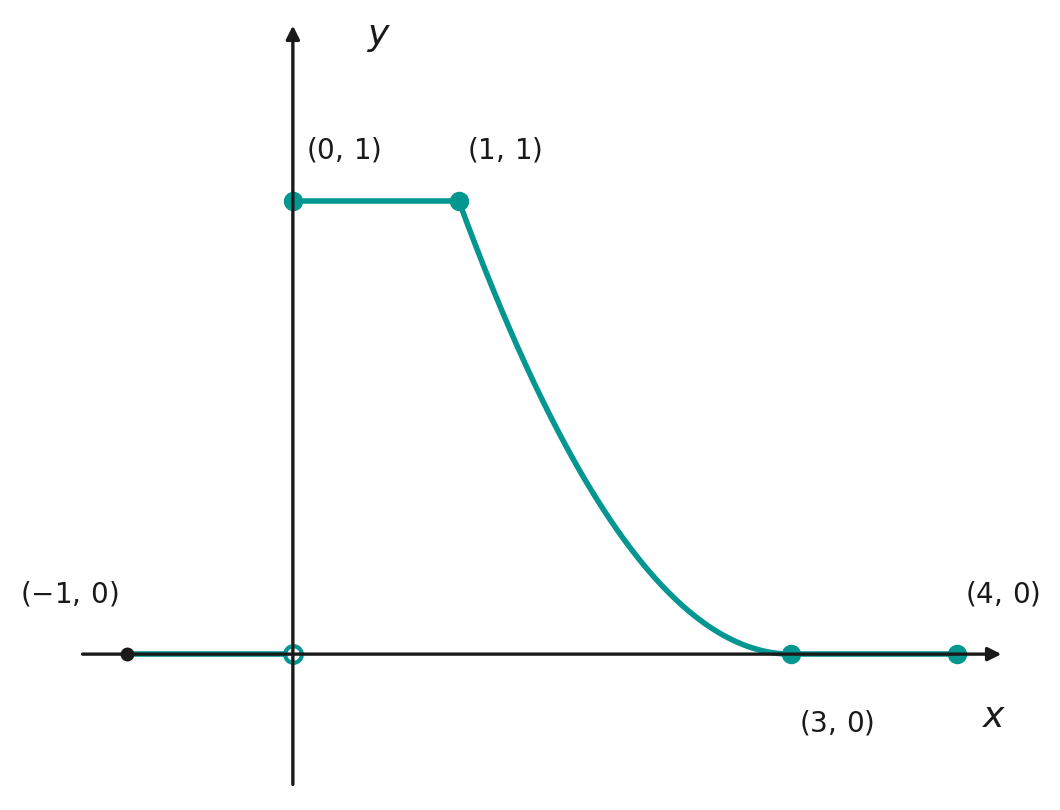
On 0≤x≤10 \leq x \leq 1, f(x)=1f(x) = 1, a horizontal segment from (0,1)(0,1) to (1,1)(1,1), both endpoints attained.

On 1<x≤31 < x \leq 3, f(x)=14(x−3)2f(x) = \frac{1}{4}(x - 3)^{2}, part of an upward parabola with vertex (3,0)(3,0). At x=1x = 1 (not included in this piece, but the value matches the flat segment already found):

f(1)=14(1−3)2=1.f(1) = \frac{1}{4}(1 - 3)^{2} = 1.

So the curve comes in at (1,1)(1,1) with a corner (the gradient jumps from 00 to −1- 1 there), then decreases to (3,0)(3,0).

Otherwise, f(x)=0f(x) = 0. For −1≤x<0- 1 \leq x < 0 this gives a horizontal segment on the xx-axis, but at x=0x = 0 itself f(0)=1f(0) = 1 (the first piece applies), so there is a jump: ff approaches 00 as x→0−x \rightarrow 0^{-} but f(0)=1f(0) = 1. For 3<x≤43 < x \leq 4, f(x)=0f(x) = 0, and since f(3)=0f(3) = 0 too, the curve meets this segment smoothly (no jump) at (3,0)(3,0).

Sketch for question 5

Note: the open circle at (0,0)(0,0) marks the value approached but not attained; (0,1)(0,1) is the actual value of f(0)f(0).

Part (iii)

2 marks

Approach

y=1+f(12x)y = 1 + f\left( \frac{1}{2}x \right) is ff scaled parallel to the xx-axis by factor 22 (replacing xx by 12x\frac{1}{2}x), then translated 11 unit in the positive yy-direction. The three break-points of ff at x=0,1,3x = 0,1,3 move to x=0,2,6x = 0,2,6 under the stretch; we only need the part of the new curve on −1≤x≤4- 1 \leq x \leq 4.

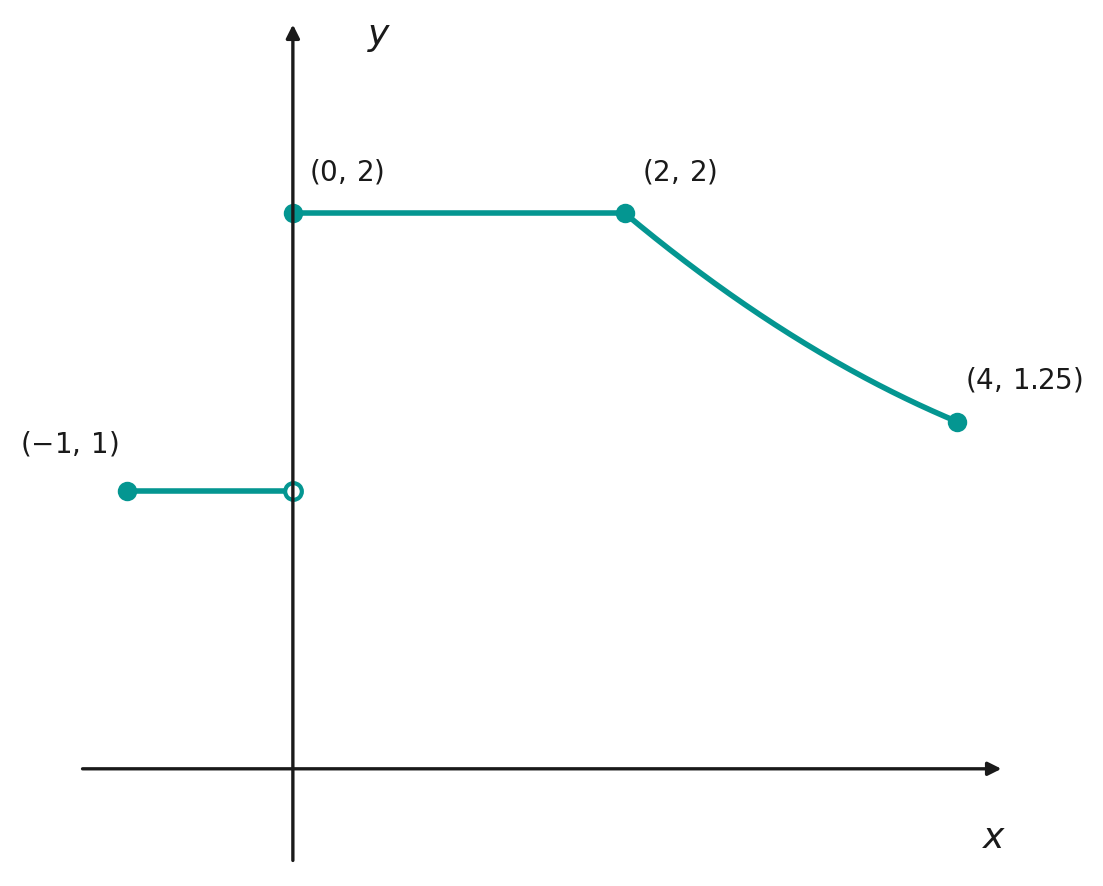
For 0≤12x≤10 \leq \frac{1}{2}x \leq 1, i.e. 0≤x≤20 \leq x \leq 2: f(12x)=1f\left( \frac{1}{2}x \right) = 1, so y=2y = 2.

For 1<12x≤31 < \frac{1}{2}x \leq 3, i.e. 2<x≤62 < x \leq 6: f(12x)=14(12x−3)2f\left( \frac{1}{2}x \right) = \frac{1}{4}\left( \frac{1}{2}x - 3 \right)^{2}, so

y=1+14(12x−3)2.y = 1 + \frac{1}{4}\left( \frac{1}{2}x - 3 \right)^{2}.

At x=4x = 4 (the right end of our domain):

y=1+14(2−3)2=1.25.y = 1 + \frac{1}{4}(2 - 3)^{2} = 1.25.

Otherwise (in particular for −1≤x<0- 1 \leq x < 0): f(12x)=0f\left( \frac{1}{2}x \right) = 0, so y=1y = 1; but at x=0x = 0 itself, y=1+f(0)=2y = 1 + f(0) = 2. As in part (ii), this is a jump: y→1y \rightarrow 1 as x→0−x \rightarrow 0^{-}, but y(0)=2y(0) = 2.

Sketch for question 5

This is how we mark, and how we teach.

Every Ten-Year Series question, worked in full, with the reasoning written out and the traps named.

Find out more