 The Learning Cave
Solution
6 marksApproach
The form is translated so that its turning point moves to , then stretched vertically by factor . Since the turning point of corresponds to on , matching turning points gives and directly; then follows from the second given point .
The turning point of is , so under the transformation to this point becomes . Since this corresponds to ,
Since also passes through ,
, , .
Approach
Since are positive with , we have , so is an upward-opening quartic with minimum value at — it lies entirely above the -axis. Reciprocating a curve that stays strictly positive and tends to turns its minimum into a maximum of , sends the large values of to values near , and never crosses the -axis (since is never ).
We first sketch : a quartic with minimum turning point and -intercept , where so the curve never meets the -axis.
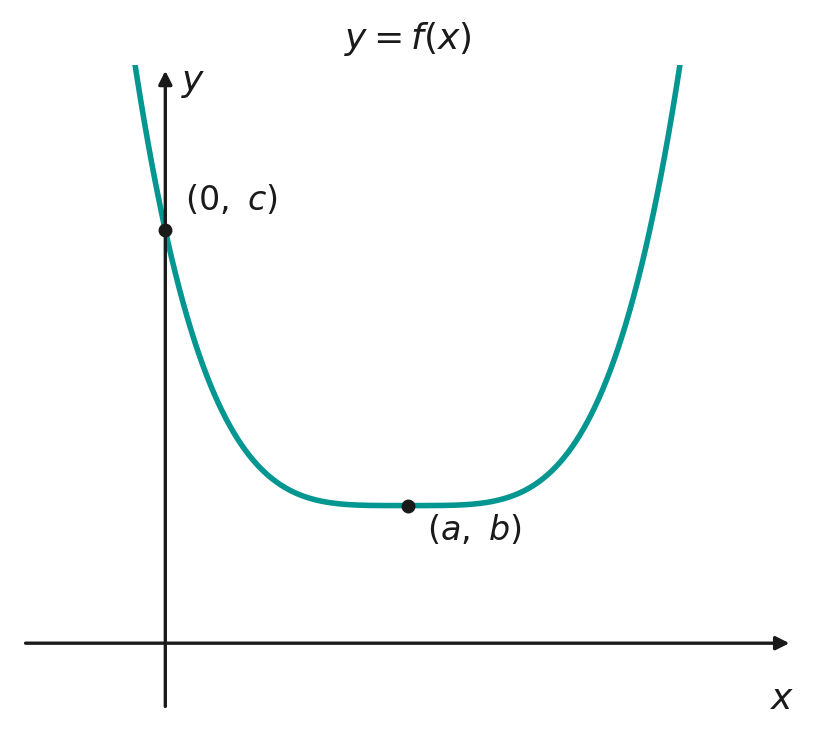
Since for all , the curve is defined for all and is always positive. As when , we get , so is a horizontal asymptote. The minimum of at becomes a maximum of there, of value . The -intercept becomes . Since is never , never crosses the -axis.
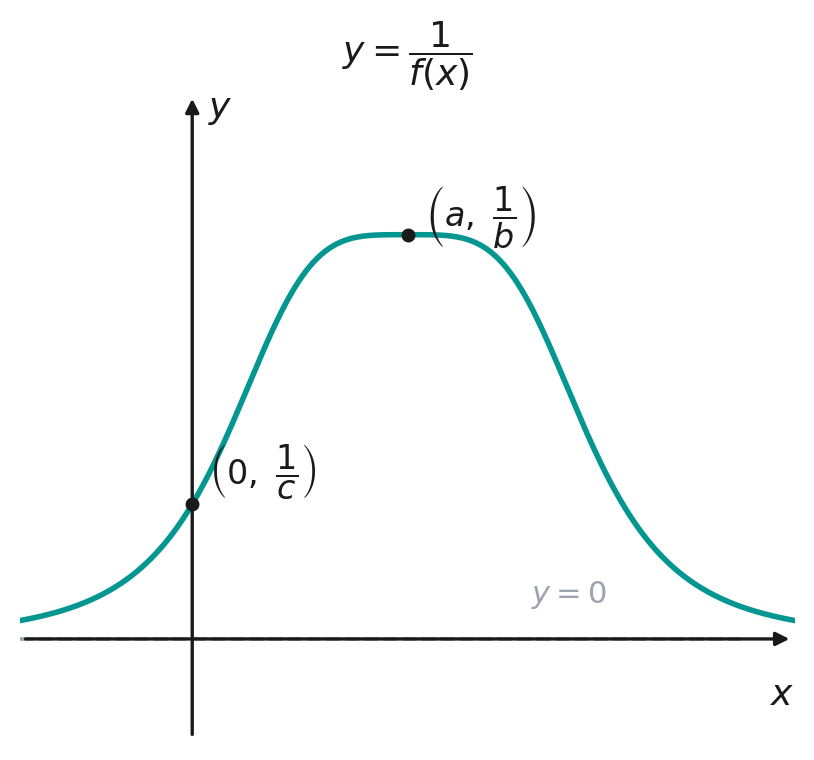
crosses the -axis at , does not cross the -axis, and has a maximum turning point at .