· H2 Mathematics — Ten-Year Series, worked ← All 10 questions

2020 A-Level · Paper 2 · Question 6

2020 H2 Maths Paper 2, Question 6

Normal distribution 10 marks sums of normal variables
Download Paper 2 solutions (PDF)

Part (i)

2 marks

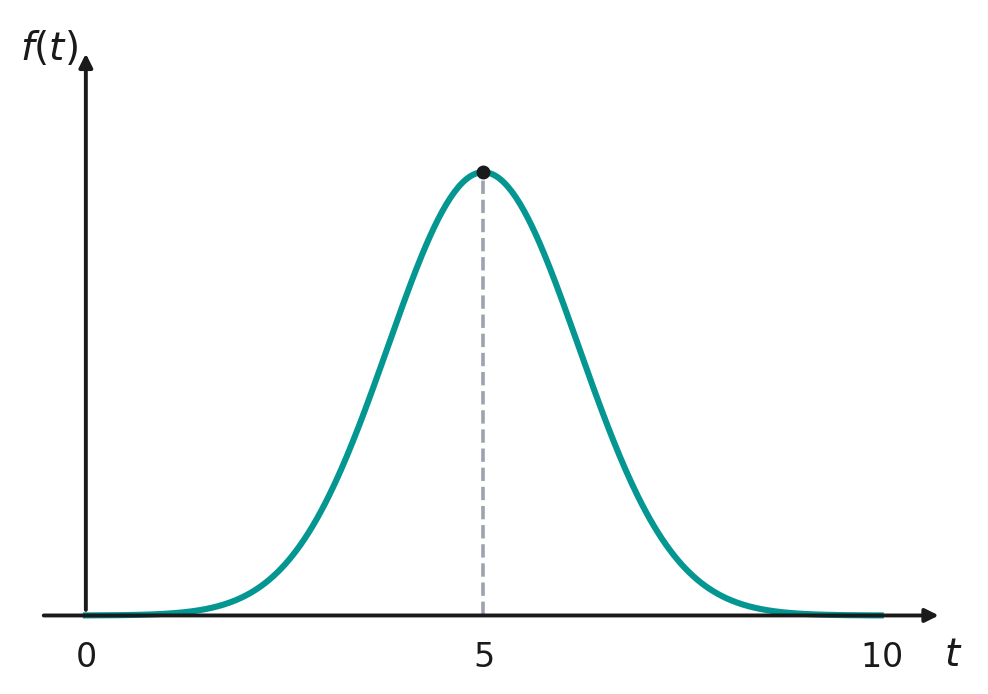
Since T∼N(5, 1.22)T \sim N\left( 5,\ {1.2}^{2} \right), the density is a symmetric bell curve centred at t=5t = 5, with the period from 8 am to 8.10 am corresponding to t∈[0,10]t \in \lbrack 0,10\rbrack.

Sketch for question 6

Part (ii)

1 mark

James leaves later than 8.06 am means T>6T > 6.

P(T>6)=0.202 (by GC)P(T > 6) = 0.202\ \text{(by GC)}

∴P(T>6)=0.202\therefore P(T > 6) = 0.202, correct to 3 s.f.

Part (iii)

2 marks

Approach

James leaves at TT minutes past 8 am and then walks for WW minutes, so his arrival time is T+WT + W minutes past 8 am. He is late if this exceeds 3030 (i.e. past 8.30 am). Since TT and WW are independent normal random variables, T+WT + W is also normal, with mean and variance found by adding.

Let T+WT + W be James’s arrival time, in minutes past 8 am, on a day he walks. Since T∼N(5, 1.22)T \sim N\left( 5,\ {1.2}^{2} \right) and W∼N(21, 32)W \sim N\left( 21,\ 3^{2} \right) are independent,

T+W∼N(5+21, 1.22+32)T + W \sim N\left( 5 + 21,\ {1.2}^{2} + 3^{2} \right)
=N(26, 10.44)= N(26,\ 10.44)

James is late if T+W>30T + W > 30, so

P(T+W>30)=0.108 (by GC)P(T + W > 30) = 0.108\ \text{(by GC)}

∴\therefore the probability that James is late for work on a day he walks is 0.1080.108, correct to 3 s.f.

Part (iv)

5 marks

Approach

we are asked for P(fine∣late)P\left( \text{fine} \mid \text{late} \right), a reversed conditional probability, so we use Bayes’ theorem. This needs P(late)P\left( \text{late} \right) overall, which splits into the walking case (already found in (iii)) and a driving case that we find the same way.

Let FF be the event that the weather is fine on a given day, and LL be the event that James is late for work that day. We are given P(F)=0.7P(F) = 0.7, so P(F′)=0.3P(F') = 0.3.

On a day the weather is not fine, James drives, arriving T+DT + D minutes past 8 am, where T∼N(5, 1.22)T \sim N\left( 5,\ {1.2}^{2} \right) and D∼N(19, 62)D \sim N\left( 19,\ 6^{2} \right) are independent, so

T+D∼N(5+19, 1.22+62)T + D \sim N\left( 5 + 19,\ {1.2}^{2} + 6^{2} \right)
=N(24, 37.44)= N(24,\ 37.44)

giving

P(L∣F′)=P(T+D>30)=0.163 (by GC)P(L \mid F') = P(T + D > 30) = 0.163\ \text{(by GC)}

From part (iii), P(L∣F)=0.10786…P(L \mid F) = 0.10786\ldots (unrounded). By the law of total probability,

P(L)P(L)
=P(L∣F)P(F)+P(L∣F′)P(F′)= P(L \mid F)P(F) + P(L \mid F')P(F')
=(0.10786…)(0.7)+(0.16340…)(0.3)= (0.10786\ldots)(0.7) + (0.16340\ldots)(0.3)
=0.12452…= 0.12452\ldots

By Bayes’ theorem,

P(F∣L)P(F \mid L)
=P(L∣F)P(F)P(L)= \frac{P(L \mid F)P(F)}{P(L)}
=(0.10786…)(0.7)0.12452…= \frac{(0.10786\ldots)(0.7)}{0.12452\ldots}
=0.606…= 0.606\ldots

∴P(F∣L)=0.606\therefore P(F \mid L) = 0.606, correct to 3 s.f.

This is how we mark, and how we teach.

Every Ten-Year Series question, worked in full, with the reasoning written out and the traps named.

Find out more