· H2 Mathematics — Ten-Year Series, worked ← All 11 questions

2023 A-Level · Paper 1 · Question 10

2023 H2 Maths Paper 1, Question 10

Differential Equations 13 marks Application Problems involving DEs
Download Paper 1 solutions (PDF)

Part (a)

5 marks

Andrew’s energy intake is CC Calories per day. Since he expends 3030 Calories per day for every kg of his mass MM, his energy expenditure is 30M30M Calories per day. Since the rate of change of mass is proportional to (intake -\text{-} expenditure),

dMdt=k(C−30M)\frac{dM}{dt} = k(C - 30M)

where kk is the constant of proportionality.  (shown)

Part (b)

1 mark
C=3300C = 3300

Explanation: for Andrew’s mass to remain constant at 110110 kg, dMdt=0\frac{dM}{dt} = 0, so from part (a), k(C−30(110))=0k\left( C - 30(110) \right) = 0. Since k≠0k \neq 0, C=30(110)=3300C = 30(110) = 3300.

Part (c)

Approach: substitute the new intake into the differential equation from (a), separate variables, and use the initial mass at the start of the plan to fix the constant of integration.

Andrew’s new energy intake is 80%80\% of 33003300, i.e. C′=0.8(3300)=2640C'= 0.8(3300) = 2640. Substituting into the differential equation from (a) with C=2640C = 2640,

dMdt=k(2640−30M)\frac{dM}{dt} = k(2640 - 30M)
=30k(264030−M)= 30k\left( \frac{2640}{30} - M \right)
=30k(88−M)= 30k(88 - M)

Separating variables,

∫188−M dM=∫30k dt\int\frac{1}{88 - M}\, dM = \int 30k\, dt
⇒−ln⁡∣88−M∣=30kt+c1\Rightarrow - \ln|88 - M| = 30kt + c_{1}
⇒ln⁡∣88−M∣=−30kt−c1\Rightarrow \ln|88 - M| = - 30kt - c_{1}
⇒88−M=Ae−30kt\Rightarrow 88 - M = Ae^{- 30kt}

where A=e−c1A = e^{- c_{1}}. Since Andrew’s mass is 110110 kg at the start of the plan (t=0t = 0),

110=88−Ae0110 = 88 - Ae^{0}
⇒A=−22\Rightarrow A = - 22

So 88−M=−22e−30kt88 - M = - 22e^{- 30kt}, i.e.

M=88+22e−30ktM = 88 + 22e^{- 30kt}
To check your answer: at t=0t = 0, M=88+22=110M = 88 + 22 = 110, matching Andrew’s initial mass on the plan. ✓

as required.  (shown)

Part (d)

4 marks

Approach: use the data point t=75t = 75, M=100M = 100 to find kk, then solve for the (non-integer) time at which M=96M = 96, and round up since the mass must fall strictly below 9696 kg.

At t=75t = 75, M=100M = 100:

100=88+22e−30k(75)100 = 88 + 22e^{- 30k(75)}
⇒12=22e−2250k\Rightarrow 12 = 22e^{- 2250k}
⇒e−2250k=611\Rightarrow e^{- 2250k} = \frac{6}{11}
⇒k=ln⁡(11/6)2250\Rightarrow k = \frac{\ln(11/6)}{2250}

Setting M=96M = 96,

96=88+22e−30kt96 = 88 + 22e^{- 30kt}
⇒e−30kt=411\Rightarrow e^{- 30kt} = \frac{4}{11}
⇒t=ln⁡(11/4)30k\Rightarrow t = \frac{\ln(11/4)}{30k}

Substituting k=ln⁡(11/6)2250k = \frac{\ln(11/6)}{2250}, so 30k=ln⁡(11/6)7530k = \frac{\ln(11/6)}{75},

t=ln⁡(11/4)ln⁡(11/6)/75t = \frac{\ln(11/4)}{\ln(11/6)/75}
=75ln⁡(11/4)ln⁡(11/6)= \frac{75\ln(11/4)}{\ln(11/6)}
≈125.2\approx 125.2

This is the total time (from the start of the plan) for the mass to reach 9696 kg. The additional days needed after day 7575:

t−75≈50.2t - 75 \approx 50.2
To check your answer: by GC, M(125.17)=88+22e−30k(125.17)≈96.0M(125.17) = 88 + 22e^{- 30k(125.17)} \approx 96.0, matching the value t≈125.2t \approx 125.2 used above. ✓

Since MM decreases continuously and must fall strictly below (not just reach) 9696 kg, the smallest whole number of additional days is 5151.

∴\therefore Andrew needs 5151 additional days on the plan.

Part (e)(i)

2 marks

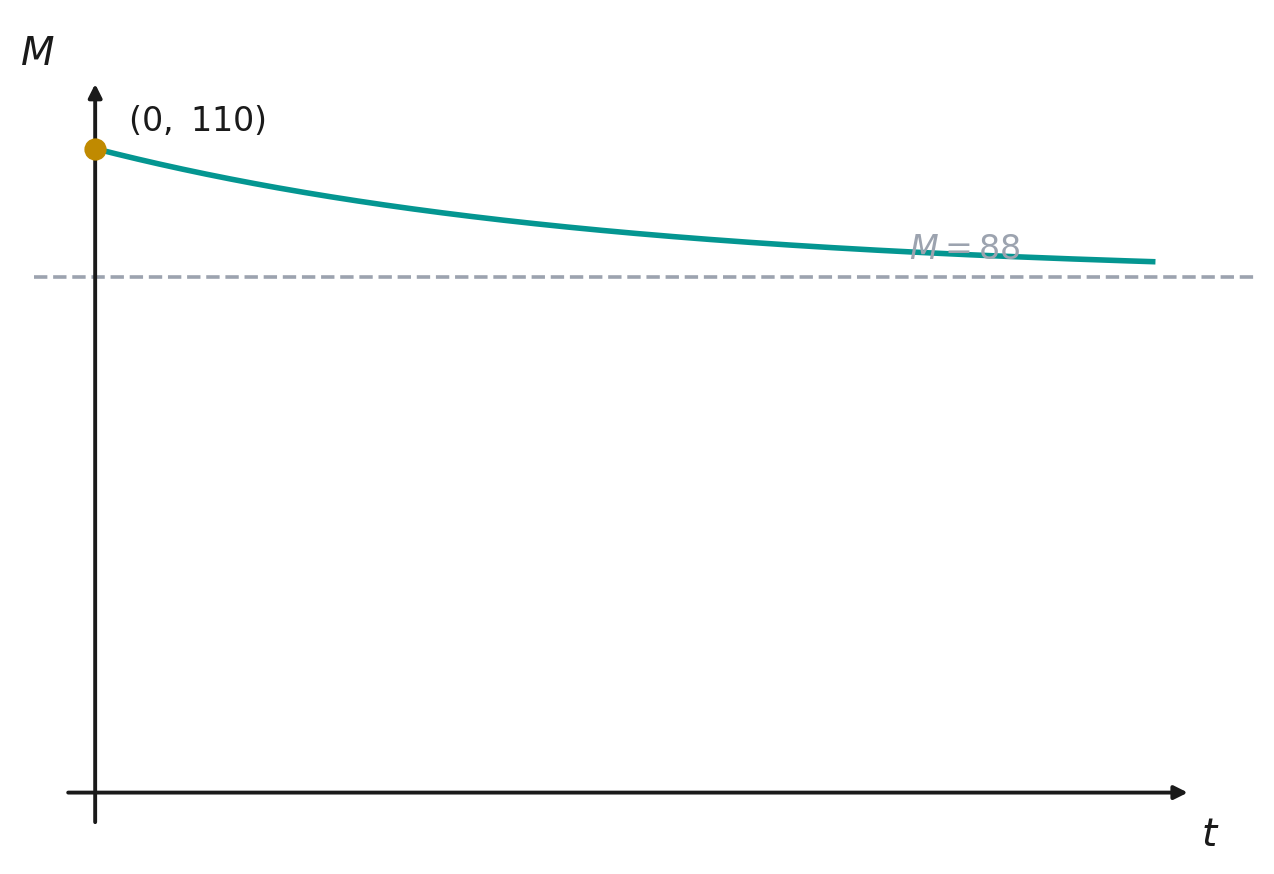
Since M=88+22e−30ktM = 88 + 22e^{- 30kt} with k>0k > 0, the term 22e−30kt22e^{- 30kt} is strictly positive for every finite tt, however large, so M>88M > 88 for all finite tt — the graph approaches the asymptote M=88M = 88 but never reaches or crosses it.

Sketch for question 10

∴\therefore since 80<8880 < 88 and MM never falls to or below 8888, Andrew cannot achieve a mass of 8080 kg using this plan.

Part (e)(ii)

1 mark
0<C<24000 < C < 2400

Explanation: for a general intake CC, the differential equation dMdt=k(C−30M)\frac{dM}{dt} = k(C - 30M) has the same structure as in part (c), with equilibrium value C30\frac{C}{30} in place of 8888. Starting from M=110M = 110, which is above the equilibrium whenever C<3300C < 3300, MM decreases towards C30\frac{C}{30} but never reaches it — exactly as in (e)(i). So Andrew’s mass reaches (and passes through) 8080 kg at some finite time only if the equilibrium itself lies strictly below 8080:

C30<80⇒C<2400\frac{C}{30} < 80 \Rightarrow C < 2400

Since CC is an energy intake it is also positive, giving 0<C<24000 < C < 2400 Calories per day.

This is how we mark, and how we teach.

Every Ten-Year Series question, worked in full, with the reasoning written out and the traps named.

Find out more